
 العربية
 简体中文
 Français
 Deutsch
 Italiano
 Português
 Español
The United States has about 340 million inhabitants and a GDP per capita of roughly 90,000 US dollars in 2025. More than 80% of people live in urban areas. It is the largest consumer market in the world, but also one where you have to decide carefully where to start: a state, a region or a single channel.
Depending on your product or service you may best start with one agent, distributor or broker for a first state or with a specific target group. As soon as you get the first reference clients, you may scale up.
Market entry approach in the USA
| Product type | Possible strategy |
| B2B products, high value, small volumes | One distributor or agent for the whole country may do, unless the sales process is complex and local service or maintenance is needed. |
| B2B products, high volumes | For logistic reasons and if applicable for service and maintenance, you may choose for regional distributors |
| B2C products with regulations per state, like medicines and alcohol | One distributor per state |
| Other B2C products | You may start with one distributor first, who is the most eager to test the market for you and support the sales with brokers. Later on you may choose more distributors and set up you local company and do some sales directly. |
Major supermarket chains in the USA
American retail is concentrated. Walmart is the largest retailer with about 569 billion dollars in US retail sales and roughly a quarter to a third of all grocery spending. Amazon passed Walmart in total revenue in 2025 with more than 716 billion dollars worldwide. Costco follows with about 3.8% of all US retail sales, ahead of The Home Depot (2.9%) and Kroger (2.8%).
Other chains that matter are Albertsons (Safeway, Vons, Jewel-Osco), Publix, Ahold Delhaize (Stop & Shop, Food Lion, Giant), H-E-B, Wegmans, Trader Joe’s and the fast-growing Aldi US and Lidl US. Private label has become a serious competitor in almost every category, which is something to check before you set your price.
Online is now a channel of its own: e-commerce reached 1.23 trillion dollars in 2025, 16.4% of all retail sales. Amazon takes 40.5% of that, Walmart.com 9.2%. For most consumer products you need a plan for both the shelf and the marketplace, including who owns the listing and the reviews.
Walmart, Kroger and Albertsons
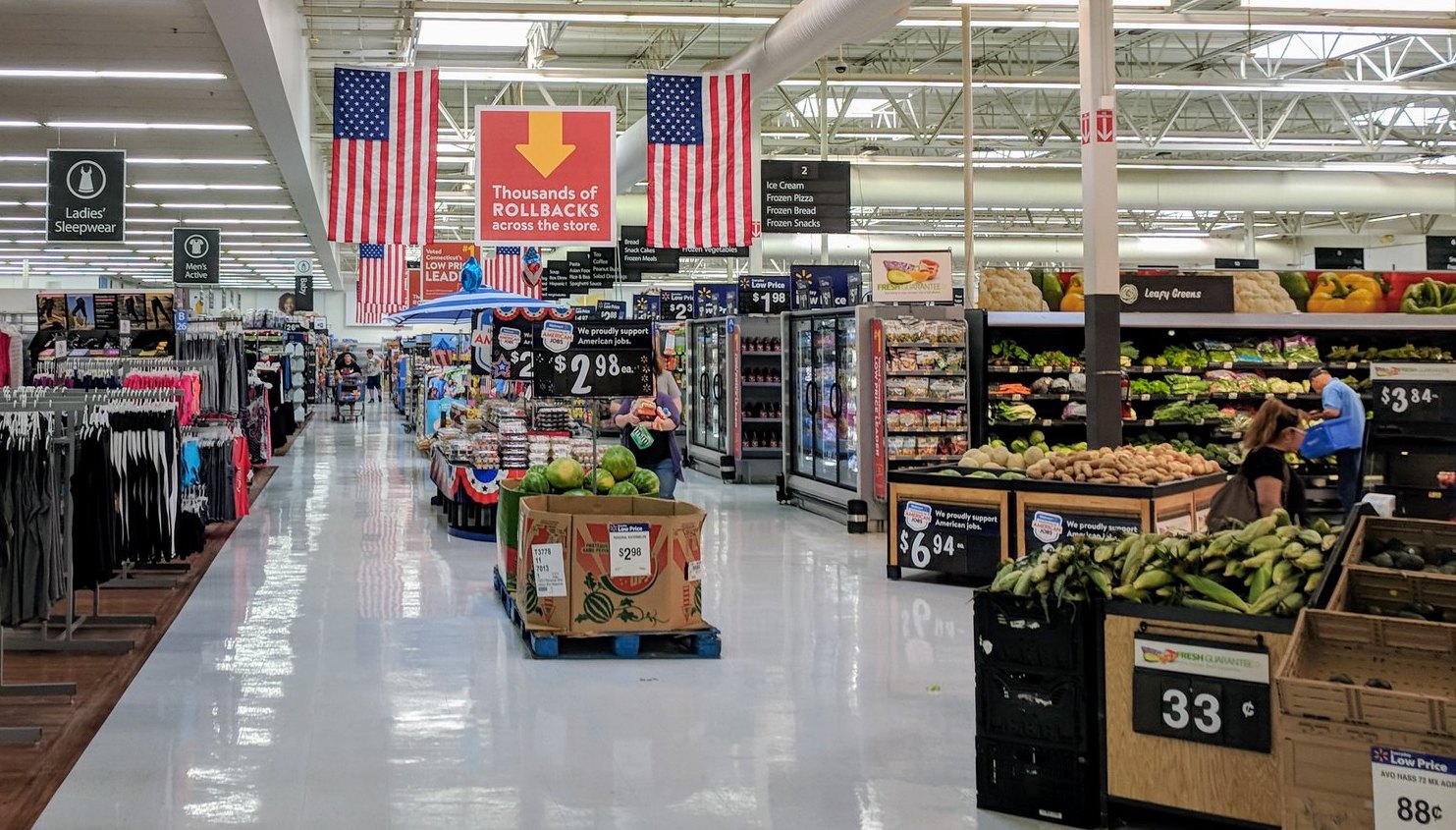
Walmart is one of the most well-known US retailers, with over 5,000 stores across the United States. Founded in 1962 by Sam Walton in Rogers, Arkansas, Walmart has become an iconic symbol of American retail. Despite its success and large footprint, Walmart’s presence in the US has been met with some criticism.
Kroger is one of America’s largest grocery companies, with more than 2,700 stores across 35 states and Washington D.C. Its merger with Albertsons was blocked by the courts at the end of 2024, so both companies continue separately — and both are investing in private label and in delivery.
Albertsons Companies is one of the largest food and drug retailers in the United States. Founded in 1939 by Joe Albertson, they currently employ over 250,000 people across 2,200 stores located in 35 states and Washington D.C. In addition to their traditional grocery store format, they also own and operate supermarkets such as Safeway, Vons, Shaw’s Supermarkets, Jewel-Osco, Acme Markets and many more.
Role of distributors and wholesalers in FMCG
The role of distributors and wholesalers in FMCG (fast-moving consumer goods) in the USA is significant. They are responsible for buying products from manufacturers and selling it to retailers, as well as providing services like inventory management, storage, transportation and more. Distributors provide a range of benefits to both manufacturers and retailers. By offering cost-efficient solutions for procuring goods from various vendors, distributors enable retailers to focus on their core competencies such as marketing or customer service.
Finding the right brokers for USA supermarkets
The role of brokers in supermarket distribution is an important one. Brokers typically work with manufacturers to determine which products will be stocked at each store; they also often negotiate prices on behalf of the retailer. In addition, brokers may provide marketing services such as coordinating advertising campaigns or managing product displays at retail locations. With their keen knowledge of the industry, brokers help ensure a successful supply chain for supermarket distribution operations.
The Fast Moving Consumer Goods (FMCG) industry is a highly competitive business sector in the United States, with a total of over 5,000 brokers operating throughout the country. FMCG brokers specialize in providing and managing logistical services for businesses that sell consumer-oriented products.
These brokers have become increasingly important due to the rise of online shopping. Online retail stores require more sophisticated delivery systems than traditional store fronts, making them reliant on FMCG brokers to ensure timely delivery of items sold through their websites. In addition, these brokers are also becoming an integral part of effective supply chain management for companies in the US market, helping them to reduce costs and increase efficiency.
Importing FMCG products in the USA
Importers of Fast Moving Consumer Goods (FMCG) into the USA must observe several requirements. The first requirement is that all goods imported into the USA must comply with domestic safety and quality standards, as outlined by the US Food and Drug Administration (FDA). This means any food, beverage, drug or cosmetic products must meet relevant FDA regulations prior to import.
In addition to this, certain categories of FMCG may require specific permits from government agencies such as the Department of Agriculture and the Bureau of Alcohol Tobacco Firearms & Explosives. Furthermore, depending on what type of product is being imported, additional documentation may be required such as a Certificate of Free Sale or a Letter Of Exemption.
You can work with a 3PL (Third Party Logistics) provider who can help you with customs clearance, document preparation, freight forwarding, and delivery. They will also be able to advise you on the most cost-effective way to transport your product into the US. You will then need to ensure that your product meets all relevant regulations and safety standards for sale in US supermarkets. Once this has been done, you will need an agreement with a wholesaler or distributor who can handle orders from retailers such as supermarkets. They may have their own requirements so it’s important that these are met before they will agree to stock your product in their warehouses or stores across America.
Role of a sales agent in the USA
You can see a sales agent as an extension of your own organisation, approaching potential customers. The role may be comparable to a broker, but an agent is more common in fashion, accessories or products for business users.